
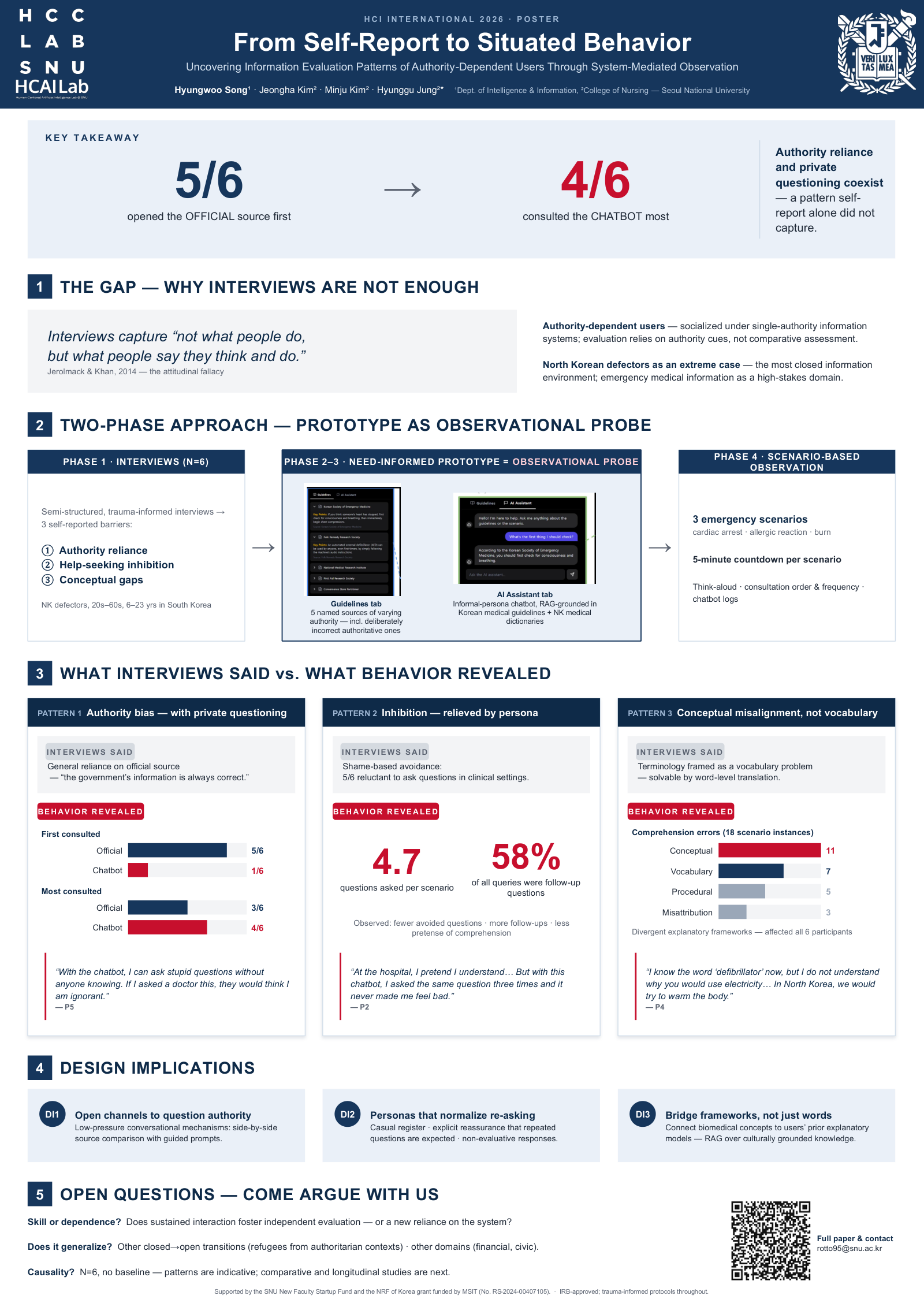
participants opened the official source first.
HCII 2026 · Poster ID 157
From Self-Report to Situated Behavior
Uncovering Information Evaluation Patterns of Authority-Dependent Users Through System-Mediated Observation
participants consulted the chatbot most often.
behavioral patterns were revealed beyond self-report.
Overview
From reported barriers to situated behavior.
Prior research on authority-dependent users has often relied on self-report methods such as interviews. This project examines what those methods can miss by studying North Korean defectors as an extreme case of users transitioning from closed to open information environments.
We first identified self-reported barriers in emergency medical information seeking, then used a need-informed prototype as an observational probe to examine how participants evaluated multiple information sources in action.
Approach
Prototype as observational probe.
Interviews
Semi-structured interviews with six North Korean defectors identified self-reported barriers.
Need-informed prototype
A multi-source emergency medical information system provided guidelines and a private AI Assistant.
Scenario observation
Think-aloud, source consultation logs, chatbot logs, and post-task interviews surfaced situated behavior.
Findings
What self-report missed.
Authority bias + private questioning
Participants often began with authoritative sources, but privately questioned the chatbot when they became uncertain.
Persona-mediated relief from inhibition
An informal chatbot persona reduced hesitation and supported repeated clarification.
Conceptual misalignment beyond vocabulary
Difficulties were not only about unfamiliar words; participants needed help connecting biomedical concepts to prior explanatory frameworks.
Design implications
Design for conditions that let people ask.
- Support low-pressure questioning through private channels for questioning authoritative information.
- Enable non-judgmental clarification by normalizing repeated questions and simple explanations.
- Bridge conceptual frameworks beyond word-level simplification or translation.
Materials
Poster and paper.
@inproceedings{song2026situated,
  title = {From Self-Report to Situated Behavior: Uncovering Information Evaluation Patterns of Authority-Dependent Users Through System-Mediated Observation},
  author = {Song, Hyungwoo and Kim, Jeongha and Kim, Minju and Jung, Hyunggu},
  booktitle = {HCI International 2026},
  year = {2026}
}